Mexico · Caribbean
Cozumel
Popular drift-diving season with generally drier weather and good visibility.
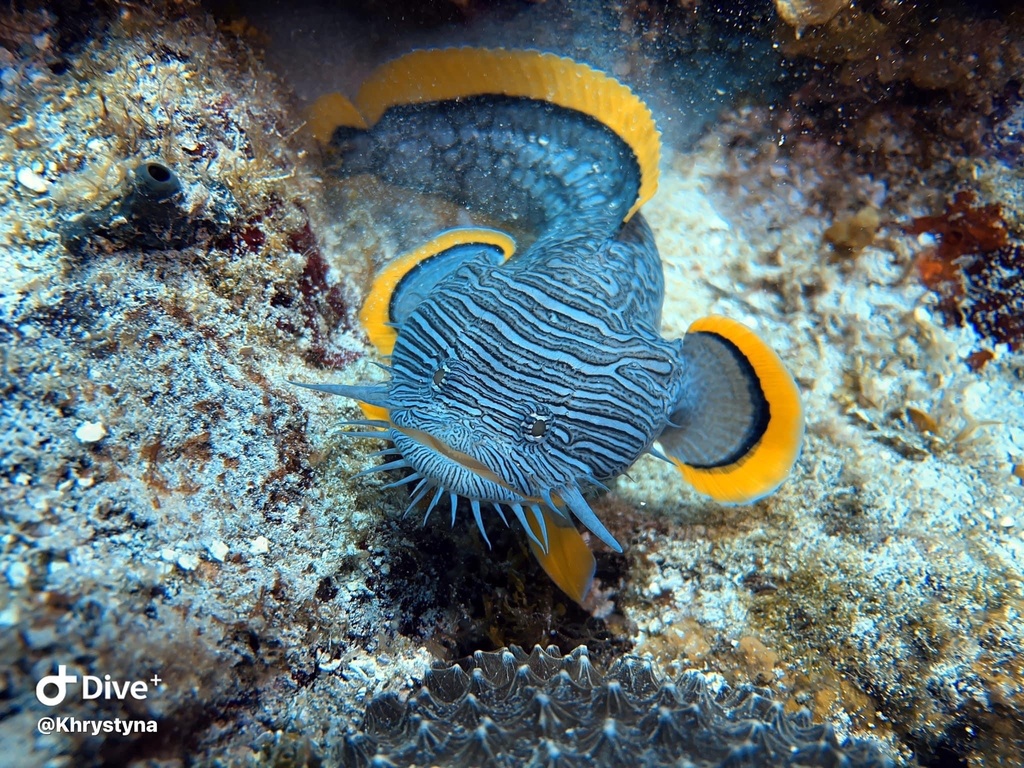
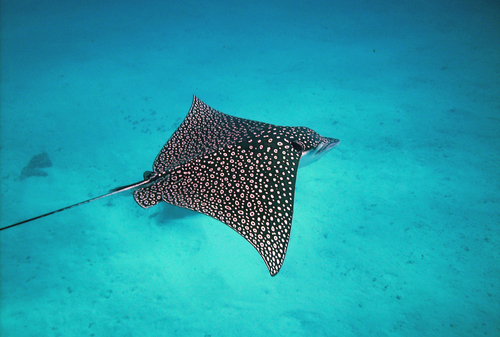
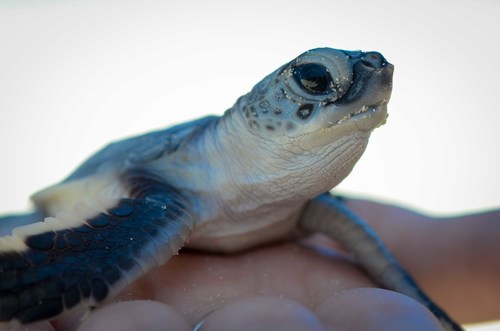
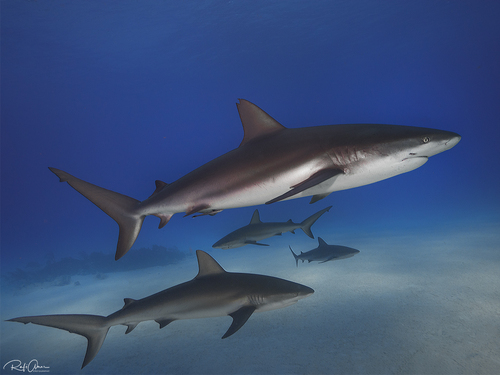
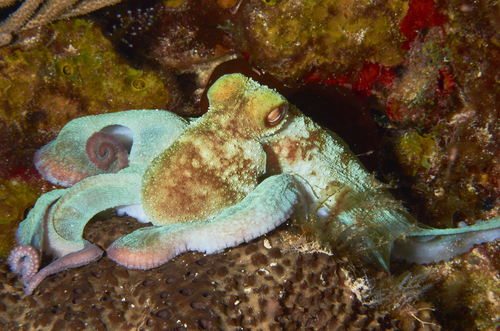
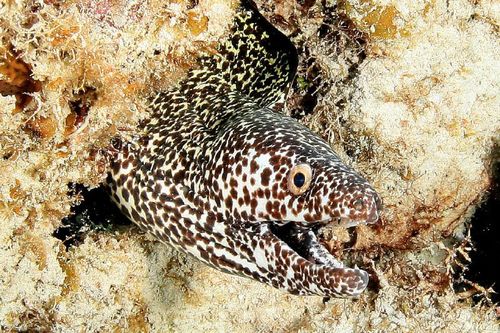
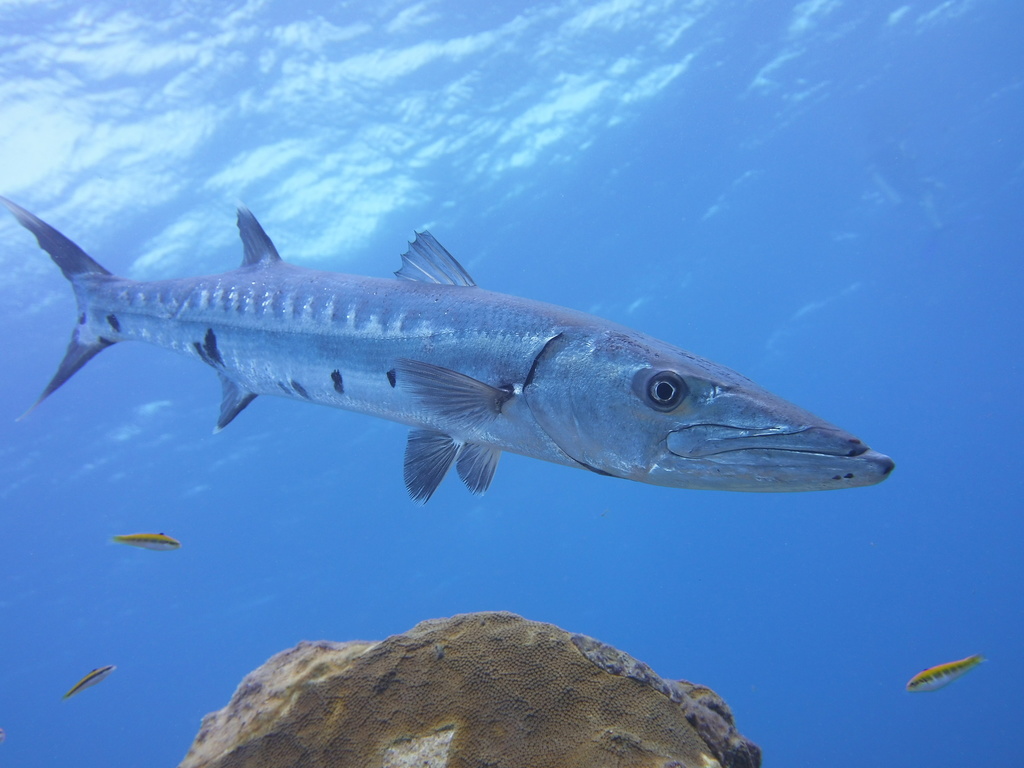
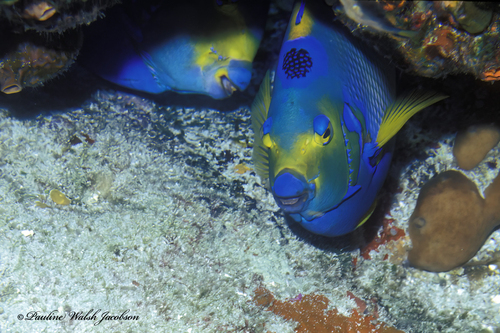
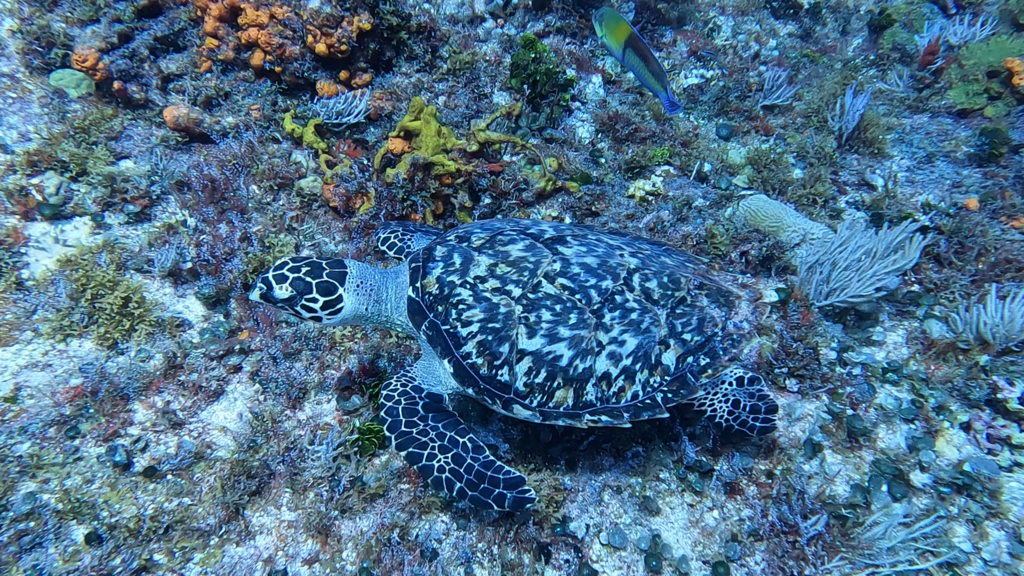
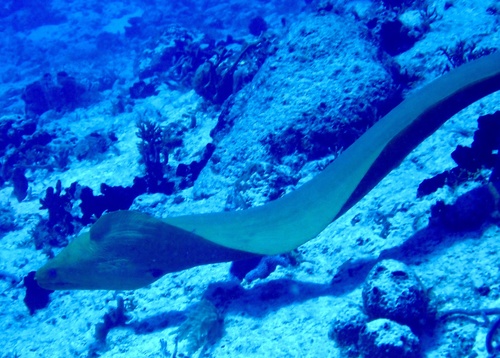
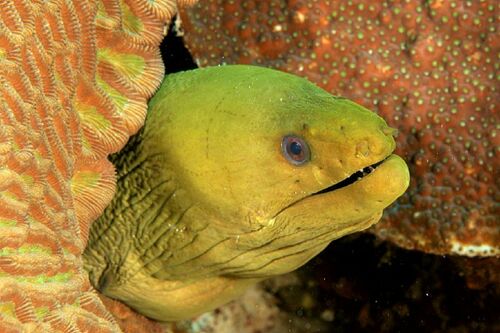
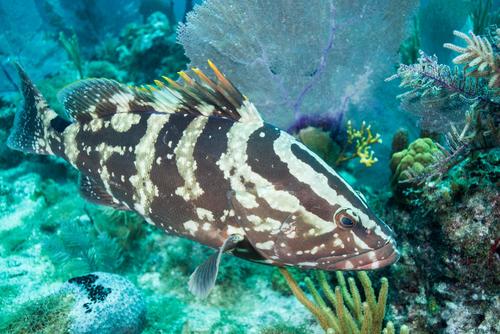
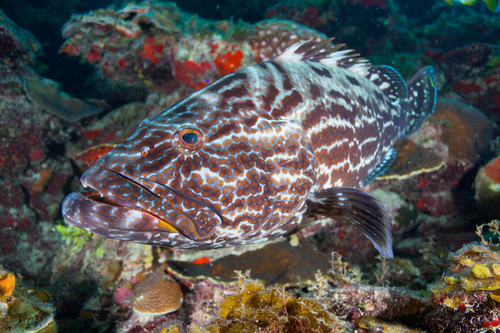
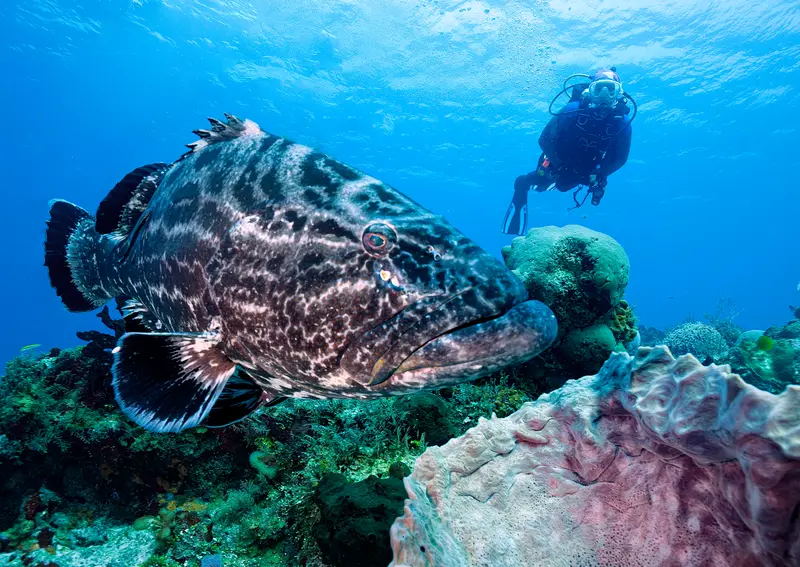
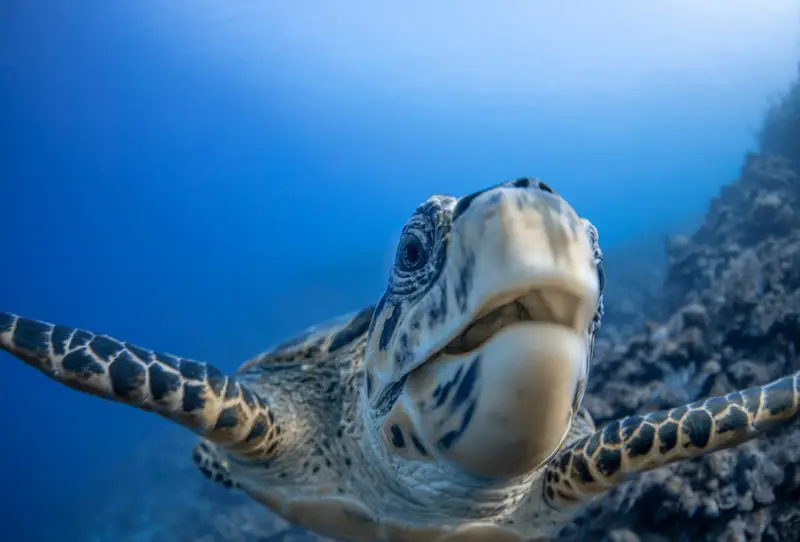
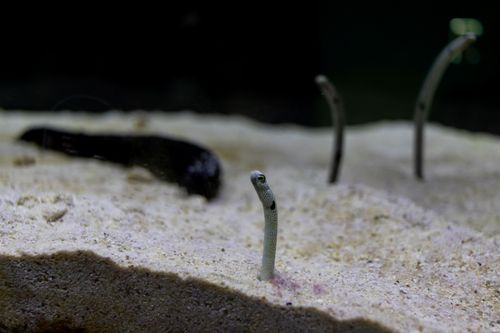
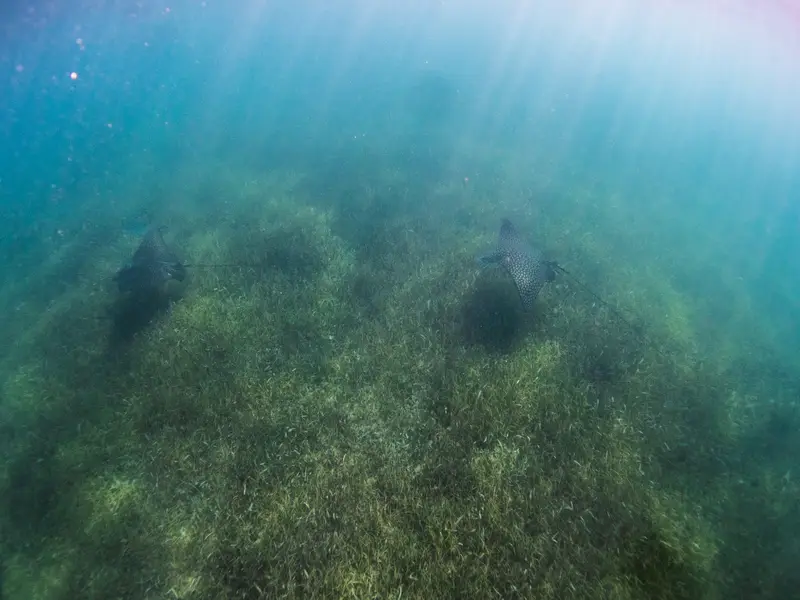
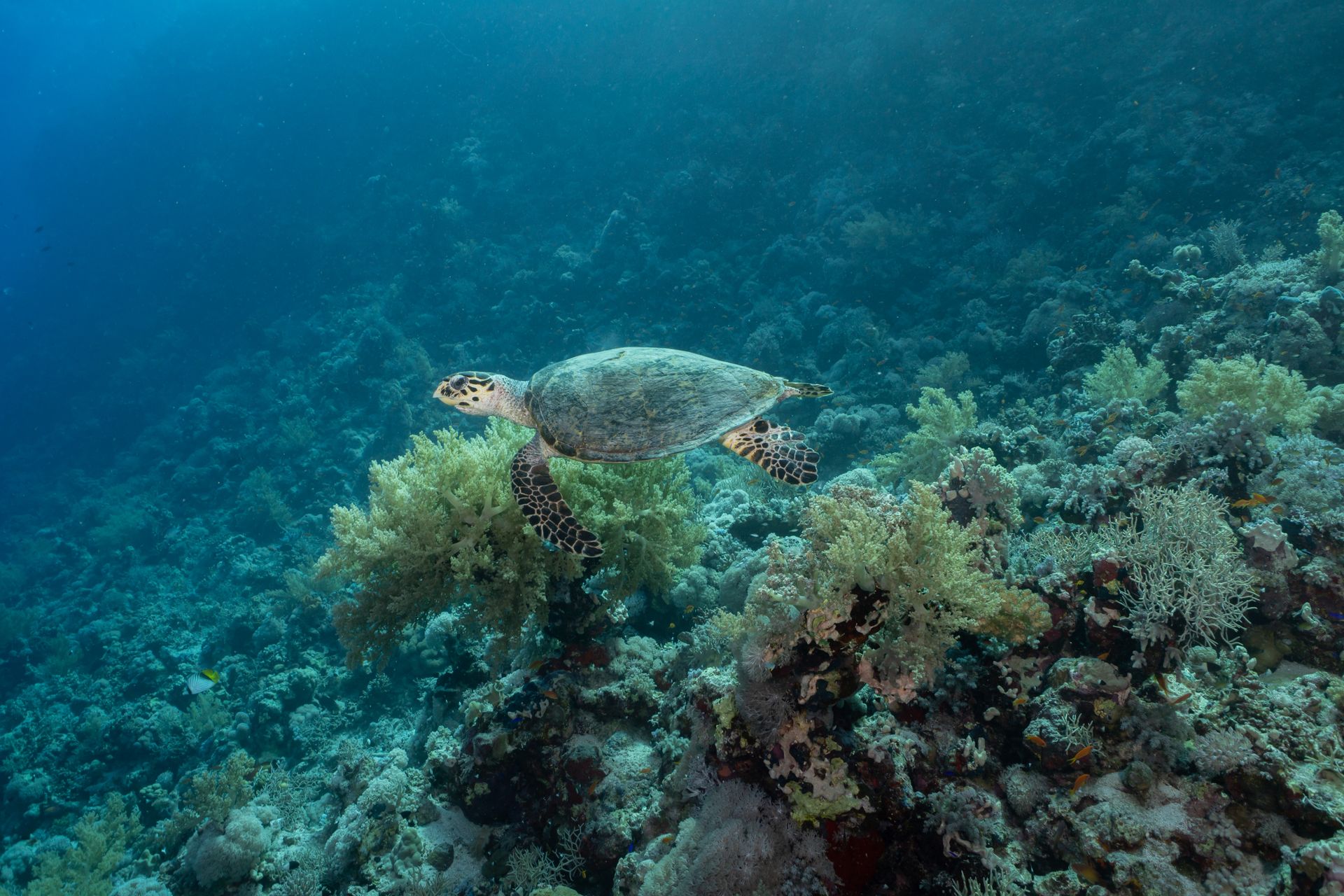
A 48km-long limestone island off the Yucatán, Cozumel is the easiest first-class drift diving in the western hemisphere: clear blue water pushed north along a chain of cuts, swim-throughs, and coral spurs that bottom out at 20–40m. Big eagle ray and turtle traffic, splendid toadfish on the sand, and a reef that has bounced back well from past bleaching.
Good season
May–September is warm (28–29°C) and calm. November–March brings cooler water and stronger north winds that can close sites. June–August is hurricane season — book flexible.
Trip duration
4–7 nights; dive ops run two-tank morning trips and afternoon shore dives.
Dive style
All drift, all the time. Boats follow the bubbles and pick you up downstream. Most sites are 12–25m; deeper sites available.
Dive level
Open Water with comfort drifting; Advanced unlocks the deeper swim-throughs at Palancar and Punta Sur.
Reef health
What you’ll actually findThis reef is losing coral faster than it's recovering. If it's on your list, go sooner — and manage expectations on coral colour.
Coral reef health
How is this calculated?On current trend, no live coral by ~2037. Losing about 1.6% cover per year — roughly 13 years of reef left to see if nothing changes.
Heat stress right now
Mild warmth. Worth watching — no bleaching yet.
NOAA Coral Reef Watch · updated May 2026 · 0 °C-week heat dose
What to expect on a dive
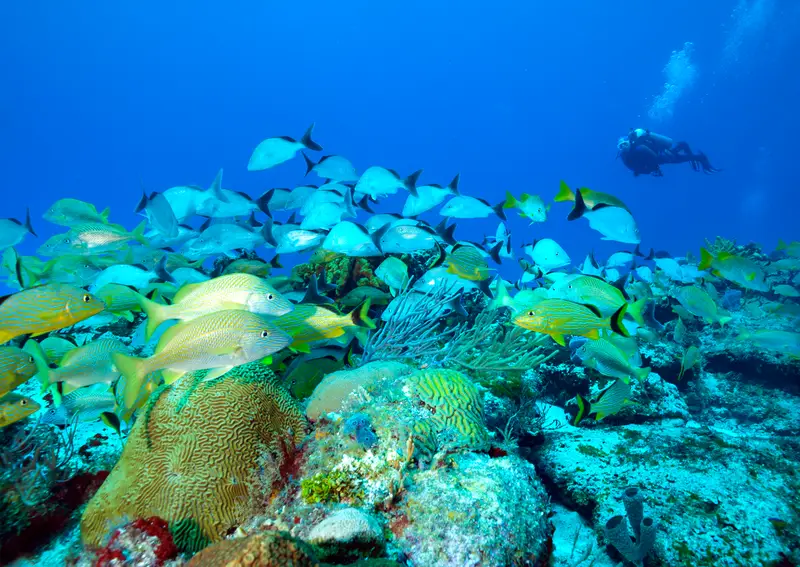
Less hard coral than the photos. Fish life, sponges, and the wall topography are still excellent. Best at depth (>20 m) and on the cooler shoulder months (Dec–Mar).
Sources, methodology, and the raw numbers
Raw observed numbers
- Coral cover: 21% (survey Oct 2024, AGRRA reef survey protocol)
- Bleached: 22%
- Recent mortality: 9%
- Caribbean-wide 2023–2024 heat dome impacted Cozumel; SCTLD (stony coral tissue loss disease) continues to compound losses.
Raw thermal numbers
- NOAA CRW alert level: Watch
- Degree Heating Weeks: 0 °C-wk
- SST anomaly: +1.3 °C
How we summarise this
Observed coral cover, bleaching, and mortality come from named in-situ surveys with a stated date and method — they describe one snapshot of one reef and do not extrapolate to neighbouring sites. Current thermal stress is satellite-derived from NOAA Coral Reef Watch at ~5 km resolution; it indicates risk, not observed coral damage. We deliberately separate observed condition, current thermal stress, and projection — and we never publish a projection without a documented model and uncertainty.
Sources
- Atlantic and Gulf Rapid Reef Assessment — AGRRA Program / Perry Institute for Marine Science
- NOAA Coral Reef Watch — U.S. National Oceanic and Atmospheric Administration
- AIMS Long-Term Monitoring Program — Australian Institute of Marine Science
- Global Coral Reef Monitoring Network — GCRMN / ICRI
- NOAA National Coral Reef Monitoring Program — NOAA Coral Reef Conservation Program
- Reef Check — Reef Check Foundation
- NOAA CoastWatch / OceanWatch — NOAA NESDIS / STAR
- Allen Coral Atlas — Arizona State University Center for Global Discovery and Conservation Science
- Great Barrier Reef Marine Park Authority — Australian Government
- International Coral Reef Initiative — ICRI Secretariat
- Reef Life Survey — Reef Life Survey Foundation
- NASA PO.DAAC — NASA Jet Propulsion Laboratory / Caltech
- Copernicus Marine Service — Mercator Ocean International for the European Union
- NASA Ocean Color (OB.DAAC) — NASA Goddard Space Flight Center / Ocean Biology Processing Group
- Argo float network — International Argo Program / UCSD
- CoralWatch — University of Queensland
- IMOS / AODN — Integrated Marine Observing System / Australian Ocean Data Network
- WRI Reefs at Risk Revisited — World Resources Institute
- Ocean Health Index — OHI partnership (Conservation International + UCSB + NCEAS)
- IPCC Special Report on the Ocean and Cryosphere (SROCC) — Intergovernmental Panel on Climate Change
- GOA-ON — Global Ocean Acidification Observing Network — GOA-ON Secretariat + IOC-UNESCO
- HAEDAT — Harmful Algae Event Database — IOC-UNESCO Intergovernmental Panel on Harmful Algal Blooms
- NCEI Marine Microplastics — NOAA National Centers for Environmental Information
Reef condition changes year to year. If you visit, consider supporting responsible-travel and conservation operators on the ground.
Pressure on this reef
Protection · fishing · what you can doProtected-area status
Strict MPAInside a strict marine protected area with active enforcement.
Fishing pressure
Moderate fishing pressureDominant pressures
- sargassum influx
- SCTLD
- tourism overdevelopment
3 Green Fins-verified operators known at this location.
What you can do
Cozumel Reefs National Park manages the western fringing reef. Dive-tag fee is mandatory. Mesoamerican Reef is partially protected by national parks. Sargassum and SCTLD are the dominant pressures. Support operators participating in coral nurseries.
Protection status sourced from Protected Planet / WDPA and refined with Marine Protection Atlas. Fishing pressure proxy is Global Fishing Watch AIS data. See the methodology for what these sources can and can’t prove.
Pollution & water-quality
What divers should knowSargassum influx
CONCERNINGSince 2018 · worst May, Jun, Jul, Aug, Sep
Massive seasonal sargassum blooms in the Mexican Caribbean choke beaches and reduce surface visibility. Worst in summer; underwater visibility on the wall is largely unaffected.
SCTLD coral disease outbreak
SEVERESince 2018
Mesoamerican Reef SCTLD outbreak has caused significant coral mortality. Active treatment dive programs operate at some sites.
What this means for your trip
Visibility on the wall remains excellent year-round. Avoid June–August if surface conditions matter — beach-level sargassum can be heavy. Support operators participating in SCTLD treatment dives.
Dive sites here
5 curatedPalancar Reef
Cozumel's signature drift along a reef complex of buttresses, swim-throughs, and coral towers that fall away into deep blue. Strong steady c…

Santa Rosa Wall
Sheer vertical wall plunging from 20 m into the abyss, cut with swim-throughs, tunnels, and overhangs draped in sponges and black coral. The…

Devil's Throat
Punta Sur's signature swim-through system — a near-vertical chimney that drops from 27 m and exits into open water on the wall at 40 m. Tigh…

Columbia Reef
A drift along the southern Cozumel reef where coral buttresses build into tall pinnacles riddled with swim-throughs, arches, and sand chutes…

C-53 Felipe Xicotencatl
The 56-metre Admirable-class minesweeper USS Scuffle (AM-298), launched in 1943 and transferred to the Mexican Navy in 1962 as the General F…
Gear
What to bringSite-specific add-ons
Some dive sites here call for extra gear. Check the individual site page for full context.
- Surface marker buoy — Every dive is a drift — SMB required for boat pickup. · Palancar Reef
- SMB + reel — Wall drift ends in open water — operators require SMB on ascent. · Santa Rosa Wall
- Dive computer — Multi-level wall profile rewards a conservative computer. · Santa Rosa Wall
- Dive light — Chimney is dark in the middle section even with surface light overhead. · Devil's Throat
What divers say
“I learned to dive in Cozumel and now I judge every drift dive against it. Most lose.”