Cayman Islands · Caribbean
Stingray City
Accessible shallow diving and snorkel encounters throughout the year.
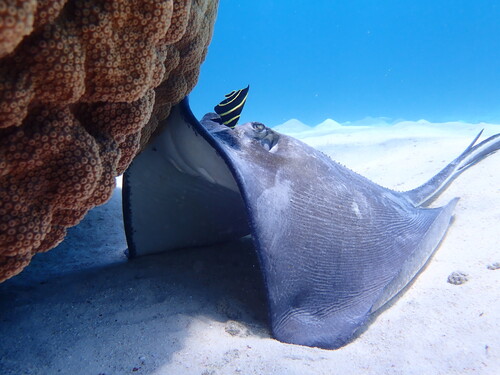
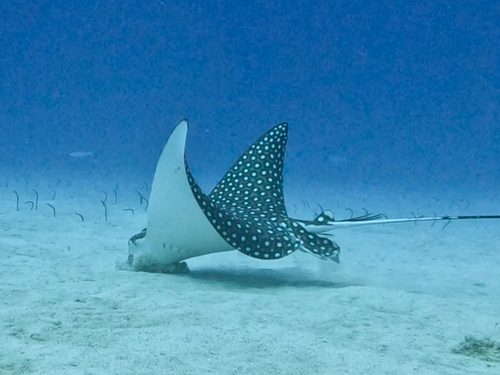
Stingray City on Grand Cayman's North Sound is a shallow sandbar where dozens of southern stingrays have been fed for decades by tour boats — divers and snorkelers can stand in chest-deep water surrounded by them. More photo op than dive site.
Good season
Year-round.
Trip duration
Half-day trip from Grand Cayman as part of a 5–7 night stay.
Dive style
Shallow (3–4m), no current, sandy bottom.
Dive level
Open Water or even snorkel-only.
Reef health
What you’ll actually findSome loss since the 2010s, but the reef still has plenty to dive. Pick depth and shoulder-season carefully.
Coral reef health
How is this calculated?On current trend, no live coral by ~2076. Losing about 0.5% cover per year — roughly 52 years of reef left to see if nothing changes.
Heat stress right now
Mild warmth. Worth watching — no bleaching yet.
NOAA Coral Reef Watch · updated May 2026 · 0 °C-week heat dose
What to expect on a dive
Sandbar interaction site — not a reef dive. Surrounding patch reefs are thinning.
Sources, methodology, and the raw numbers
Raw observed numbers
- Coral cover: 26% (survey Sep 2024, AGRRA reef survey protocol)
- Bleached: 14%
- Recent mortality: 5%
- Caribbean MPA — observed condition reflects the thinning regional pattern.
Raw thermal numbers
- NOAA CRW alert level: Watch
- Degree Heating Weeks: 0 °C-wk
- SST anomaly: +1.6 °C
How we summarise this
Observed coral cover, bleaching, and mortality come from named in-situ surveys with a stated date and method — they describe one snapshot of one reef and do not extrapolate to neighbouring sites. Current thermal stress is satellite-derived from NOAA Coral Reef Watch at ~5 km resolution; it indicates risk, not observed coral damage. We deliberately separate observed condition, current thermal stress, and projection — and we never publish a projection without a documented model and uncertainty.
Sources
- Atlantic and Gulf Rapid Reef Assessment — AGRRA Program / Perry Institute for Marine Science
- NOAA Coral Reef Watch — U.S. National Oceanic and Atmospheric Administration
- AIMS Long-Term Monitoring Program — Australian Institute of Marine Science
- Global Coral Reef Monitoring Network — GCRMN / ICRI
- NOAA National Coral Reef Monitoring Program — NOAA Coral Reef Conservation Program
- Reef Check — Reef Check Foundation
- NOAA CoastWatch / OceanWatch — NOAA NESDIS / STAR
- Allen Coral Atlas — Arizona State University Center for Global Discovery and Conservation Science
- Great Barrier Reef Marine Park Authority — Australian Government
- International Coral Reef Initiative — ICRI Secretariat
- Reef Life Survey — Reef Life Survey Foundation
- NASA PO.DAAC — NASA Jet Propulsion Laboratory / Caltech
- Copernicus Marine Service — Mercator Ocean International for the European Union
- NASA Ocean Color (OB.DAAC) — NASA Goddard Space Flight Center / Ocean Biology Processing Group
- Argo float network — International Argo Program / UCSD
- CoralWatch — University of Queensland
- IMOS / AODN — Integrated Marine Observing System / Australian Ocean Data Network
- WRI Reefs at Risk Revisited — World Resources Institute
- Ocean Health Index — OHI partnership (Conservation International + UCSB + NCEAS)
- IPCC Special Report on the Ocean and Cryosphere (SROCC) — Intergovernmental Panel on Climate Change
- GOA-ON — Global Ocean Acidification Observing Network — GOA-ON Secretariat + IOC-UNESCO
- HAEDAT — Harmful Algae Event Database — IOC-UNESCO Intergovernmental Panel on Harmful Algal Blooms
- NCEI Marine Microplastics — NOAA National Centers for Environmental Information
Reef condition changes year to year. If you visit, consider supporting responsible-travel and conservation operators on the ground.
Pressure on this reef
Protection · fishing · what you can doProtected-area status
Strict MPAInside a strict marine protected area with active enforcement.
Fishing pressure
Moderate fishing pressureDominant pressures
- lionfish invasion
- warming
- SCTLD disease
3 Green Fins-verified operators known at this location.
What you can do
Caribbean MPAs (Cayman, Saba, Bonaire, Bonaire, Cuba JdR) are some of the world's best-managed. Pay the conservation tag fee at entry and join a lionfish cull if offered.
Protection status sourced from Protected Planet / WDPA and refined with Marine Protection Atlas. Fishing pressure proxy is Global Fishing Watch AIS data. See the methodology for what these sources can and can’t prove.
Dive sites here
2 curated
Stingray City
A patch of white sand inside Grand Cayman's North Sound where dozens of southern stingrays patrol at around 12 feet. The rays began gatherin…

USS Kittiwake
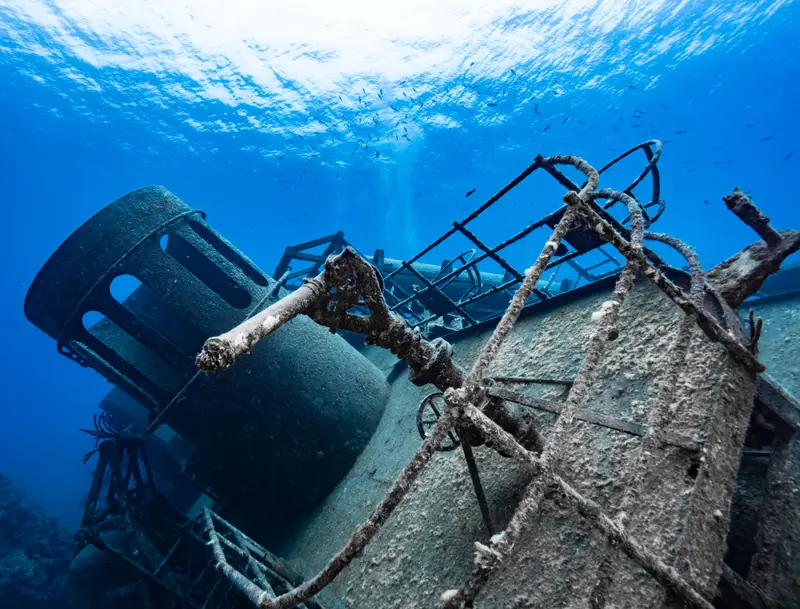
The ex-USS Kittiwake, a 76 m Chanticleer-class submarine rescue ship commissioned in 1946, was scuttled off the northern end of Seven Mile B…
Gear
What to bringSite-specific add-ons
Some dive sites here call for extra gear. Check the individual site page for full context.
- Primary dive light — Interior decks and the lower engine spaces are dark and silty once you leave the daylight zone. · USS Kittiwake
- Dive computer — Repeated up-and-down through the multi-deck structure between 10 and 20 m builds bottom time. · USS Kittiwake
What divers say
“Touristy and worth it. The rays are absurdly habituated and the photos are inevitable.”