Planning a trip?
Hotels, dive operators, gear, and how to get here are on the Ras Mohammed location page.
Overview
British WWII armed merchant steamship bombed by two Luftwaffe Heinkel He 111s on October 6, 1941 while at anchor at Safe Anchorage F in the Strait of Gubal. The blast tore open Hold 4 — loaded with ammunition — and split the 128-meter hull. The wreck sits upright on a sand bottom with its decks at 18 m and the propeller at 32 m, the holds still packed with Bedford trucks, Norton 16H and BSA M20 motorcycles, Bren-gun carriers, Lee-Enfield rifles, aircraft parts, Wellington boots, and two LMS Stanier 8F locomotives blown onto the seabed on either side of the hull. Rediscovered by Jacques Cousteau in 1955 and reopened to recreational divers in the early 1990s, it is the most-dived wreck in the world.
Briefing note
Advanced Open Water with deep and wreck experience strongly recommended; full wreck-penetration requires PADI/SSI Wreck Diver certification and a primary plus backup torch. Mooring lines are mandatory for descent and ascent because surface currents in the Strait of Gubal can hit 2 knots — drift-off scenarios have caused fatalities. Nitrox extends bottom time on the deeper holds and propeller. Avoid kicking up silt inside the holds, and never remove or touch the cargo or human remains — the wreck is a designated war grave for the 9 crew lost in 1941. Sharm el-Sheikh has the nearest hyperbaric chamber. Site can be crowded with 20+ boats midday in high season; first dive of the day is usually the cleanest.
What you'll see
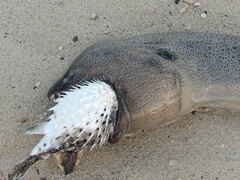
7 species curated- year-roundGiant morayPeak: Jan · Feb · Mar · Apr · May · Jun · Jul · Aug · Sep · Oct · Nov · Dec
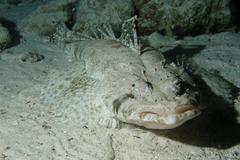
- year-roundCrocodilefishPeak: Jan · Feb · Mar · Apr · May · Jun · Jul · Aug · Sep · Oct · Nov · Dec
- year-roundBatfishPeak: Jan · Feb · Mar · Apr · May · Jun · Jul · Aug · Sep · Oct · Nov · Dec
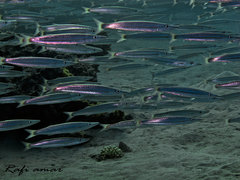
- year-roundYellowtail barracudaPeak: Jan · Feb · Mar · Apr · May · Jun · Jul · Aug · Sep · Oct · Nov · Dec
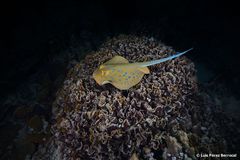
- year-roundBluespotted stingrayPeak: Jan · Feb · Mar · Apr · May · Jun · Jul · Aug · Sep · Oct · Nov · Dec
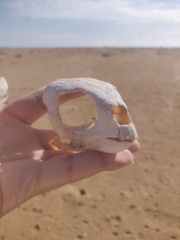
- seasonalHawksbill turtlePeak: Apr · May · Jun · Jul · Aug · Sep · Oct
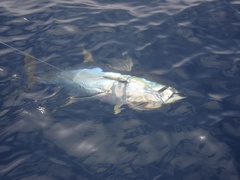
- seasonalTunaPeak: Mar · Apr · May · Jun · Sep · Oct · Nov
Sightings evidence
1 record on file- high confidenceGiant moray
- Last confirmed
- May 2026
- Recent records
- 130 within 10 km
- Cluster months
- Year-round
Sources & methodology
How we summarise this
We aggregate confirmed occurrence records from GBIF and OBIS within a fixed radius of each dive site. Occurrence records confirm presence and reveal seasonality clustering, but they DO NOT measure per-dive probability — there is no eligible-effort denominator. We deliberately do not publish a numeric '% chance of sighting' from this data.
Sources
- Global Biodiversity Information Facility — GBIF Secretariat
- Ocean Biodiversity Information System — IOC-UNESCO
- OBIS-SEAMAP — Duke University Marine Geospatial Ecology Lab / OBIS
- iNaturalist — California Academy of Sciences & National Geographic Society
- IUCN Red List of Threatened Species — International Union for Conservation of Nature
- WoRMS — World Register of Marine Species — Flanders Marine Institute (VLIZ)
- FishBase — FishBase Consortium
- Atlas of Living Australia — CSIRO / GBIF Australia
- REEF Volunteer Fish Survey — Reef Environmental Education Foundation
The wreck
Ship history- War grave
Freighter · United Kingdom
SS Thistlegorm
- Built
- 1940
- Sunk
- Oct 6, 1941
- Length
- 128 m
- Tonnage
- 4,898
- Diveable depth
- 16–32 m
- How she sank
- Sunk in wartime
British armed merchant freighter sunk by Heinkel He 111 bombers in the Red Sea while carrying war supplies to North Africa. The cargo holds — motorcycles, Lee-Enfield rifles, trucks, locomotives, ammunition — remain in place and form one of the most iconic wreck dives in the world.
Notable features
- BSA motorcycles
- Bedford trucks
- two locomotives on the seabed
- anti-aircraft gun
- rifles in crates
Vessel histories sourced from the Naval History and Heritage Command (DANFS), NOAA ENC Direct, and editorial research. Bathymetry per GEBCO. See the methodology for limits.
Conditions
| Month | Water | Visibility | Current |
|---|---|---|---|
| Jan | 21–23 °C | 15–25 m | moderate |
| Feb | 20–22 °C | 15–25 m | moderate |
| Mar | 21–23 °C | 20–30 m | moderate |
| Apr | 22–24 °C | 20–30 m | moderate |
| May | 24–26 °C | 20–30 m | moderate |
| Jun | 26–28 °C | 20–30 m | moderate |
| Jul | 27–29 °C | 20–30 m | moderate |
| Aug | 28–30 °C | 20–30 m | moderate |
| Sep | 27–29 °C | 20–30 m | moderate |
| Oct | 26–28 °C | 20–30 m | moderate |
| Nov | 24–26 °C | 20–30 m | moderate |
| Dec | 22–24 °C | 15–25 m | moderate |
Season calendar
Peak season highlighted · current month outlined
Next step
Book your trip to Ras Mohammed
Hotels, liveaboards, dive operators, gear recommendations, and travel logistics for the whole region.
Plan your trip →Some links earn us a commission. Learn more