Planning a trip?
Hotels, dive operators, gear, and how to get here are on the Florida Keys location page.
Overview
159 m former missile-tracking ship scuttled off Key West in 2009 — the second-largest artificial reef in the world. Massive radar dishes, gun mounts, and accessible interior compartments draw advanced and tech divers. Top of the superstructure at 15 m, deck at 30 m.
What you'll see
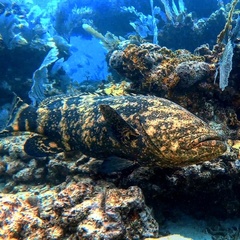
4 species curated- seasonalGoliath grouperPeak: Aug · Sep · Oct
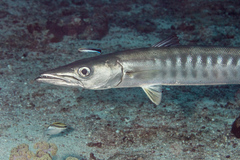
- year-roundSchooling barracuda
- year-roundPermit
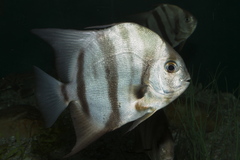
- year-roundAtlantic spadefish
Sightings evidence
1 record on file- medium confidenceGoliath grouper
- Last confirmed
- Oct 2025
- Recent records
- 45 within 10 km
- Cluster months
- Aug, Sep, Oct
Sources & methodology
How we summarise this
We aggregate confirmed occurrence records from GBIF and OBIS within a fixed radius of each dive site. Occurrence records confirm presence and reveal seasonality clustering, but they DO NOT measure per-dive probability — there is no eligible-effort denominator. We deliberately do not publish a numeric '% chance of sighting' from this data.
Sources
- Global Biodiversity Information Facility — GBIF Secretariat
- Ocean Biodiversity Information System — IOC-UNESCO
- OBIS-SEAMAP — Duke University Marine Geospatial Ecology Lab / OBIS
- iNaturalist — California Academy of Sciences & National Geographic Society
- IUCN Red List of Threatened Species — International Union for Conservation of Nature
- WoRMS — World Register of Marine Species — Flanders Marine Institute (VLIZ)
- FishBase — FishBase Consortium
- Atlas of Living Australia — CSIRO / GBIF Australia
- REEF Volunteer Fish Survey — Reef Environmental Education Foundation
The wreck
Ship history- National marine sanctuary
Warship · United States
USNS Hoyt S. Vandenberg
- Built
- 1944
- Sunk
- May 27, 2009
- Length
- 159 m
- Tonnage
- 17,120
- Diveable depth
- 15–43 m
- How she sank
- Scuttled as artificial reef
World War II troop transport and later Cold War missile-tracking ship, scuttled off Key West as the second-largest artificial reef in the world. The Cold-War radar dishes are still in place on the deck.
Notable features
- satellite dishes
- ECM antennas
- navigation bridge
- swim-throughs on the superstructure
Vessel histories sourced from the Naval History and Heritage Command (DANFS), NOAA ENC Direct, and editorial research. Bathymetry per GEBCO. See the methodology for limits.
Conditions
| Month | Water | Visibility | Current |
|---|---|---|---|
| Jan | 21–23 °C | 15–25 m | moderate |
| Feb | 21–23 °C | 15–25 m | moderate |
| Mar | 22–24 °C | 15–25 m | moderate |
| Apr | 24–26 °C | 20–30 m | moderate |
| May | 26–28 °C | 20–30 m | moderate |
| Jun | 28–29 °C | 20–30 m | moderate |
| Jul | 29–30 °C | 20–30 m | moderate |
| Aug | 29–30 °C | 20–30 m | moderate |
| Sep | 28–29 °C | 15–25 m | moderate |
| Oct | 26–28 °C | 15–25 m | moderate |
| Nov | 24–26 °C | 15–25 m | moderate |
| Dec | 22–24 °C | 15–25 m | moderate |
Season calendar
Peak season highlighted · current month outlined
Gear for this site
Beyond the basic kit- Dive light — Interior compartments are dark and silt-prone.
- Wreck-trained guide — Penetration sections require formal training.
Next step
Book your trip to Florida Keys
Hotels, liveaboards, dive operators, gear recommendations, and travel logistics for the whole region.
Plan your trip →Some links earn us a commission. Learn more