Ulong Channel
Rock Islands · Palau
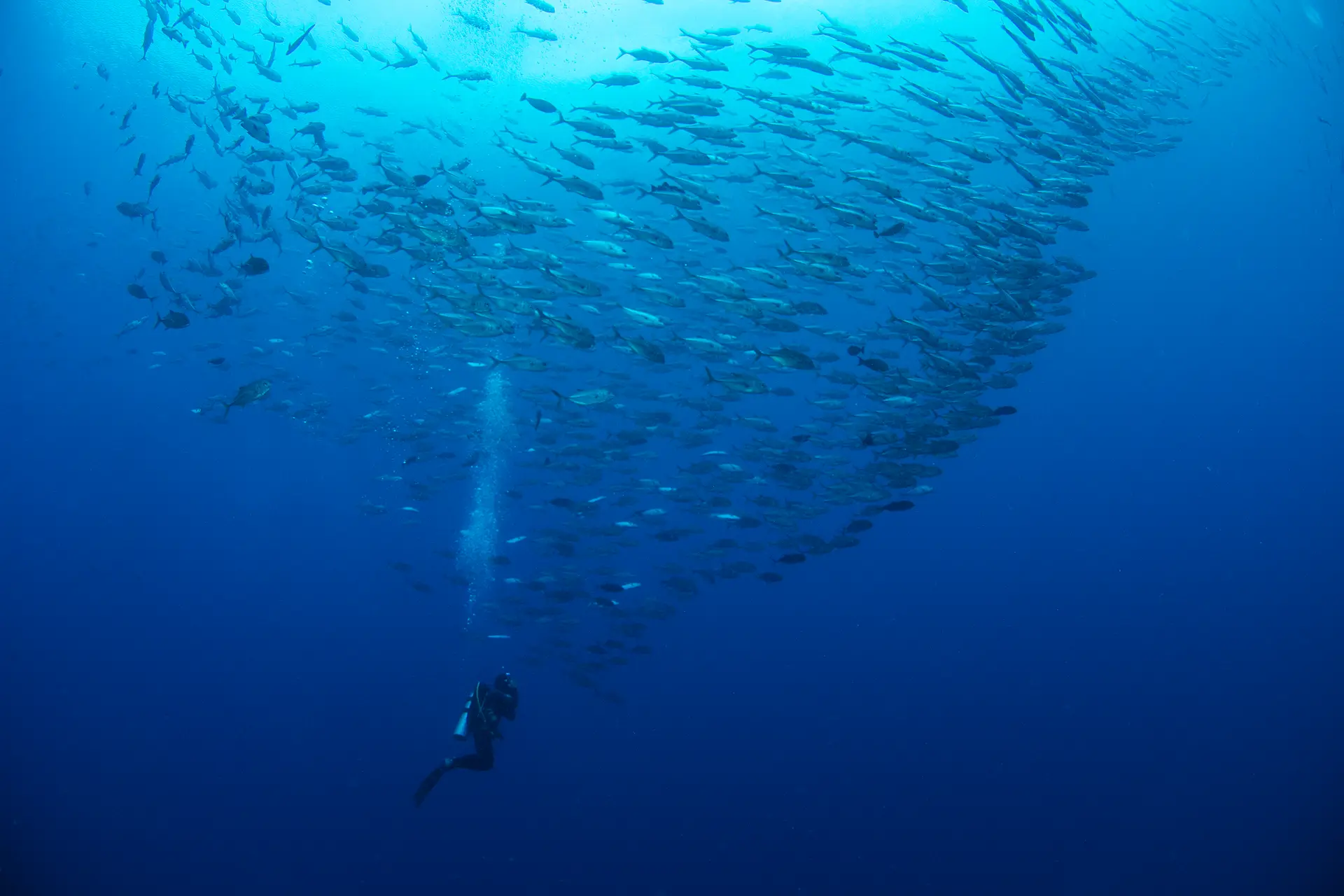
A natural cut through the barrier reef west of Ulong Island, often picked as Palau's signature drift. Enter at the channel mouth around 18-20 m where grey reef and whitetip sharks patrol the sandy runoff, hook in to a rocky ledge to watch the parade, then unhook and let the incoming current carry you down a coral lined corridor past a 5-7 m wall of lettuce coral (Pavona) and schools of jacks, snapper, and barracuda. April-July full moons bring spawning aggregations of camouflage groupers.
Conditions
Depth
5 to 30 m
Open water and up
Current
Can be moderate
Can pick up on the edge
Visibility
20 to 30 m
Clearest in the calm season
Water
28 to 30°C
Tropical wetsuit
Month by month
| Month | Jan | Feb | Mar | Apr | May | Jun | Jul | Aug | Sep | Oct | Nov | Dec |
|---|---|---|---|---|---|---|---|---|---|---|---|---|
| Water (°C) | 28 | 28 | 28 | 28 | 29 | 29 | 29 | 29 | 29 | 28 | 28 | 28 |
| Vis (m) | 20 | 20 | 25 | 25 | 20 | 15 | 15 | 15 | 15 | 20 | 25 | 25 |
| Current | Strong | Strong | Strong | Strong | Strong | Strong | Moderate | Moderate | Moderate | Moderate | Strong | Strong |
Your chances of seeing each animal
Grey reef shark
Last confirmed Apr 15, 2026 · 130 records
Almost always
Nearly every dive
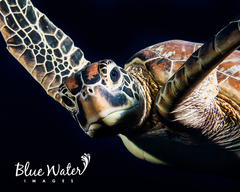
Green turtle
Last confirmed May 24, 2026 · 19 records
Very likely
Most dives
Whitetip reef shark
Last confirmed May 30, 2026 · 59 records
Very likely
Most dives
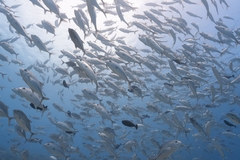
Bigeye trevally
Last confirmed Mar 2, 2026 · 14 records
Very likely
Most dives
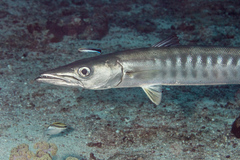
Chevron barracuda
Last confirmed Jan 10, 2026 · 7 records
Likely
About 6 in 10 dives
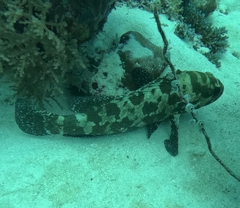
Camouflage grouper
Last confirmed Apr 14, 2025 · 4 records
Sometimes
About 1 in 3 dives
Gear
Basic kit
For this site
- Reef hook · Hook-in at the channel entrance is the standard technique to watch sharks and snappers without finning against the current.
- Surface marker buoy · Drift exits the channel into open water — operators require SMB for pickup.↗