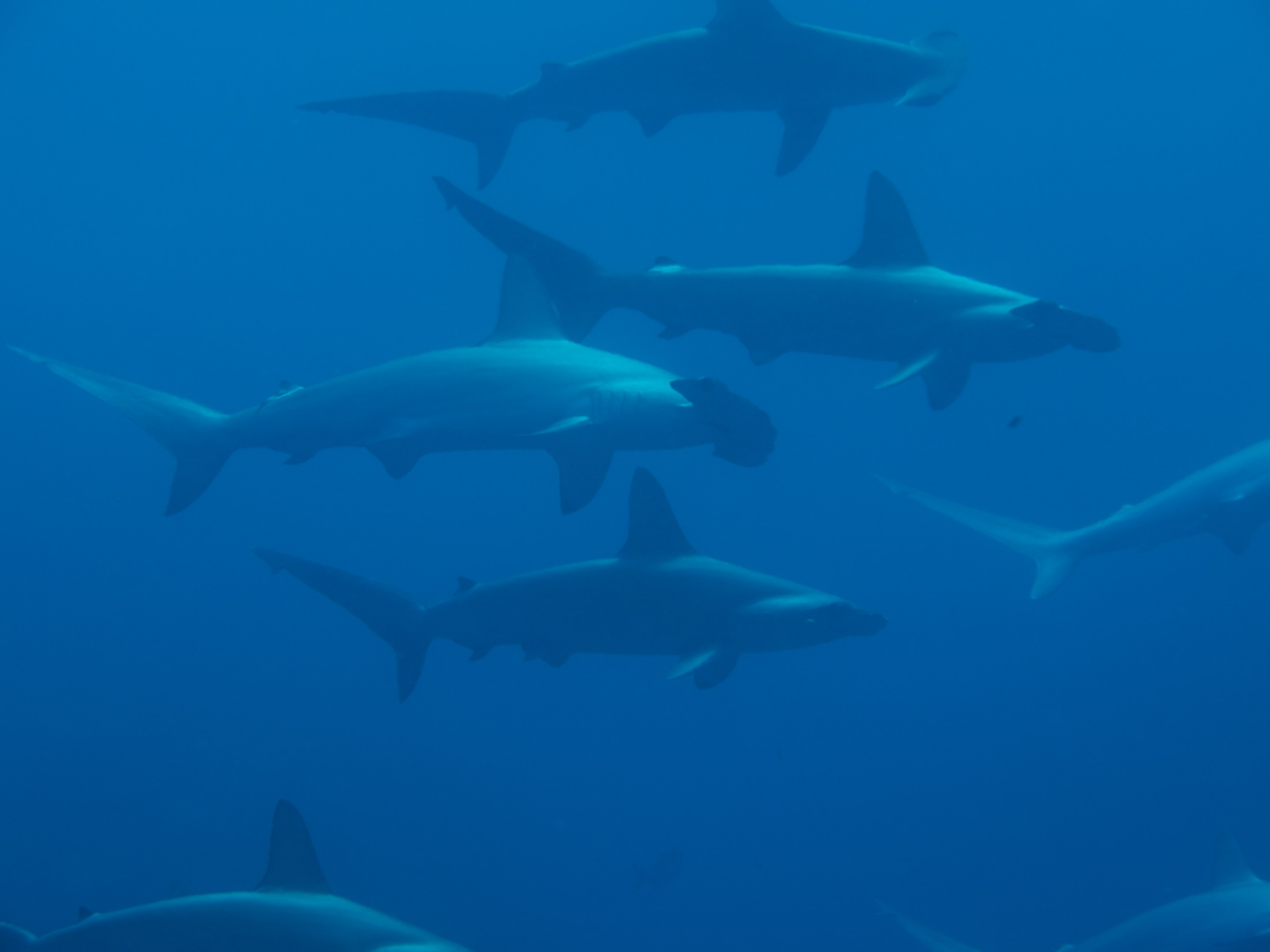
shark aggregation
Scalloped Hammerhead Schools
Scalloped hammerhead · Sphyrna lewini
Daytime schooling aggregations of scalloped hammerheads at seamounts and current-swept island walls.
When
Where
- Best current option
Cocos Island
Costa Rica
Jun · Jul · Aug · Sep · Oct · Nov
Liveaboard-only seamount with reliable hammerhead aggregations at cleaning stations.
Open Cocos Island in atlas → - Best current option
Wolf Island
Ecuador
Jun · Jul · Aug · Sep · Oct · Nov
Northern Galápagos current convergence; one of the densest schooling sites in the world.
Open Wolf Island in atlas → - Best current option
Darwin Island
Ecuador
Jun · Jul · Aug · Sep · Oct · Nov
Sister site to Wolf with comparable aggregation density.
Open Darwin Island in atlas → - Best current option
Malpelo
Colombia
Jun · Jul · Aug · Sep · Oct · Nov
UNESCO-protected seamount with hammerhead and silky shark aggregations.
Open Malpelo Island in atlas → - Still happens
Socorro
Mexico
Nov · Dec · Jan · Feb · Mar · Apr
Hammerheads appear seasonally alongside the more famous giant manta encounters.
Open Socorro Islands in atlas →
Ethics
Stay grouped, breathe shallowly, no flash photography at the school. Operator briefings supersede general guidance.
Operators
We don’t accept payment for listings. Operators are included when they appear in regulator permit lists or have an established track record at the site — we mark each one as verified only when we’ve cross-checked the permit ourselves.
Cocos Island, Costa Rica
Undersea Hunter Group
listed only$5500–$8500 · 10 days · max 18
Pioneering Cocos liveaboard operator since the 1990s.
Visit operator site →
Wolf Island, Ecuador
Galapagos Master
listed only$6500–$9500 · 7 days · max 16
Master Liveaboards-operated Wolf/Darwin itinerary; northern Galápagos focus.
Visit operator site →
Required experience
Advanced Open Water minimum, comfort with strong current, blue-water hangs, and deep multilevel profiles. Reef-hook training recommended.
Conservation
Scalloped hammerheads are Critically Endangered (IUCN). Aggregations are sensitive to repeated disturbance.
Limitations
Sources & methodology
How we summarise this
Schooling behavior is operator-reported. Aggregation density varies with current, lunar phase, and temperature.
Sources
- Global Biodiversity Information Facility — GBIF Secretariat
- Ocean Biodiversity Information System — IOC-UNESCO