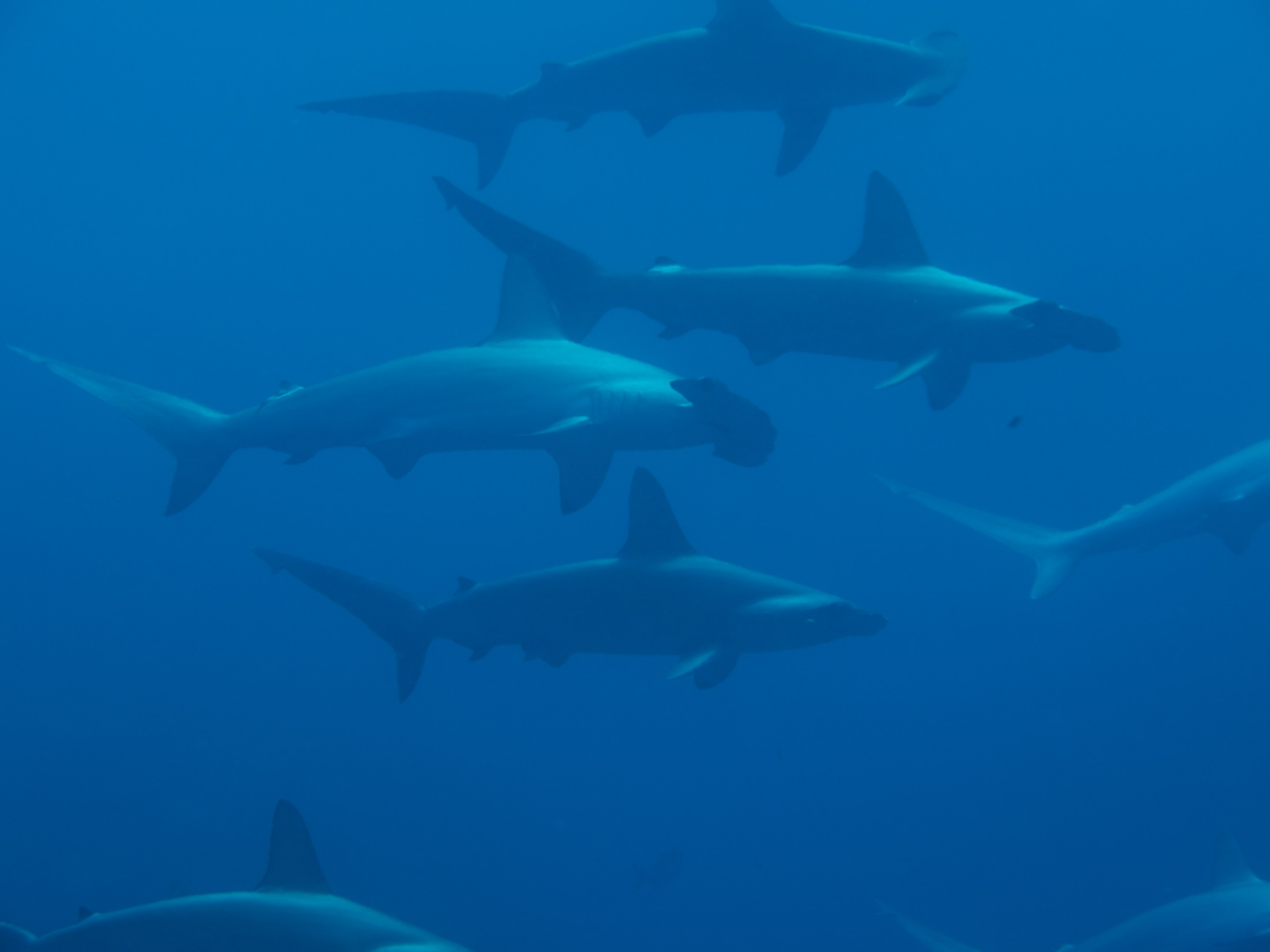
Where to see Scalloped Hammerhead Schools in 2026
Scalloped hammerhead · Sphyrna lewini
Daytime schooling aggregations of scalloped hammerheads at seamounts and current-swept island walls.
Best months
Difficulty & experience
Advanced Open Water minimum, comfort with strong current, blue-water hangs, and deep multilevel profiles. Reef-hook training recommended.
Best locations
- Cocos Islandprimary
Costa Rica
Liveaboard-only seamount with reliable hammerhead aggregations at cleaning stations.
- Wolf Islandprimary
Ecuador
Northern Galápagos current convergence; one of the densest schooling sites in the world.
- Darwin Islandprimary
Ecuador
Sister site to Wolf with comparable aggregation density.
- Malpelo Islandprimary
Colombia
UNESCO-protected seamount with hammerhead and silky shark aggregations.
- Socorro Islandssecondary
Mexico
Hammerheads appear seasonally alongside the more famous giant manta encounters.
Sites at these locations
- Bajo Alcyone
Cocos Island, Costa Rica
Submerged seamount 25 m below the surface, rising from the deep. Hammerhead schools in the hundreds patrol the up-current edge. Cold thermocline, surge, and current — the most famous dive in the Eastern Pacific.
- Darwin's Arch (The Pillars)
Darwin Island, Ecuador
Liveaboard-only seamount off the remote Darwin Island. Schooling scalloped hammerheads in the hundreds, whale sharks in season, silky sharks circling the surface. Strong current, surge, cold thermoclines, and the second-best shark-density site on the planet. The arch itself collapsed in 2021; the pillars remain.
- Shark Bay (Wolf Island)
Wolf Island, Ecuador
Northern point of Wolf Island where hammerhead schools sweep through in the hundreds. Hook into the rocks at 18 m, watch the sharks pass at arm's length. Whale sharks in season; dolphin pods occasionally crash the dive.
- The Landslide (El Derrumbe)
Wolf Island, Ecuador
A boulder slope on Wolf Island's southeast corner that looks like the cliff let go yesterday — broken rock and rubble spilling into the blue. Drop to 10 m and work down to a cleaning station where scalloped hammerheads stack up by the dozen while barberfish pick them clean. Galápagos sharks patrol the edge; from June to November whale sharks, many of them pregnant females, cruise the deep water beyond. Moray eels jam the cracks, and eagle rays and yellowfin tuna ride past in the current.
- Dirty Rock (Roca Sucia)
Cocos Island, Costa Rica
Cluster of jagged pinnacles off Cocos's northwest corner, streaked with guano that gives the rock its name. Drop down a wall to 20–25 m and hold position at the barberfish cleaning station — scalloped hammerheads queue overhead in schools that can number in the hundreds, sliding in one at a time to be cleaned. Galapagos sharks, marbled rays, and bigeye trevally fill the blue between passes. Strong current and surge are the price of admission.
- The Boiler
Socorro Islands, Mexico
A submerged volcanic pinnacle off the northwest side of San Benedicto Island, rising from roughly 40m to within about 6m of the surface. Named for the way swell breaks over its two 'horns' and makes the water appear to boil, the site functions as a giant manta cleaning station where Mobula birostris are tended by clarion angelfish and routinely engage divers at close range. Bottlenose dolphins, multiple shark species and the occasional humpback whale song round out a small, circumnavigable seamount that can be looped twice in a single dive.
Plan a trip
Methodology
How we picked these locations
We use the sighting-occurrence-cluster methodology: encounter regions are ranked from primary to closed based on documented occurrence records, operator continuity, and regulator permit status. We never publish per-trip sighting probabilities — “best” here means the most reliably documented region for this encounter, not a guarantee.
We aggregate confirmed occurrence records from GBIF and OBIS within a fixed radius of each dive site. Occurrence records confirm presence and reveal seasonality clustering, but they DO NOT measure per-dive probability — there is no eligible-effort denominator. We deliberately do not publish a numeric '% chance of sighting' from this data.
Schooling behavior varies with current, lunar phase, and water temperature. Encounter frequency is reported by liveaboard operators rather than measured against a survey denominator.